

Einstein’s Theory of Relativity reveals that time is not constant — it stretches, bends, and flows differently depending on speed and gravity.
This illustration summarizes the three major scientific pathways to travel forward in time:
- 🚀 Relativistic Velocity (Time Dilation)
At velocities approaching the speed of light (≈ 300,000 km/s), time slows down dramatically for the traveler.
A few years aboard a near-light-speed spacecraft could equal centuries passing on Earth. - 🕳️ Gravitational Time Dilation (Black Hole Proximity)
Intense gravitational fields — like those around supermassive black holes — warp spacetime, causing time to move slower.
One hour near the event horizon might correspond to years or decades for an observer far away. - 🌠 Wormholes (Einstein–Rosen Bridges)
Hypothetical tunnels connecting two regions of spacetime.
If one entrance experiences slower time (due to velocity or gravity), crossing through could lead you directly into the future relative to the other end.
However, stability would require exotic matter — something yet to be discovered.
🧠 Summary:
Physics allows travel forward in time through relativity and gravity.
But reversing time — returning to the past — remains impossible under known physical laws.
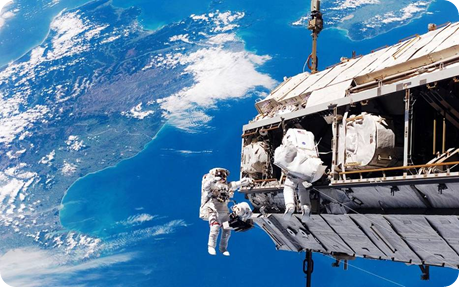
⏳ We already live slightly in the future — astronauts aboard the ISS experience microseconds of time dilation every day.












 Mundhir
 A s t r O c e a n O m y